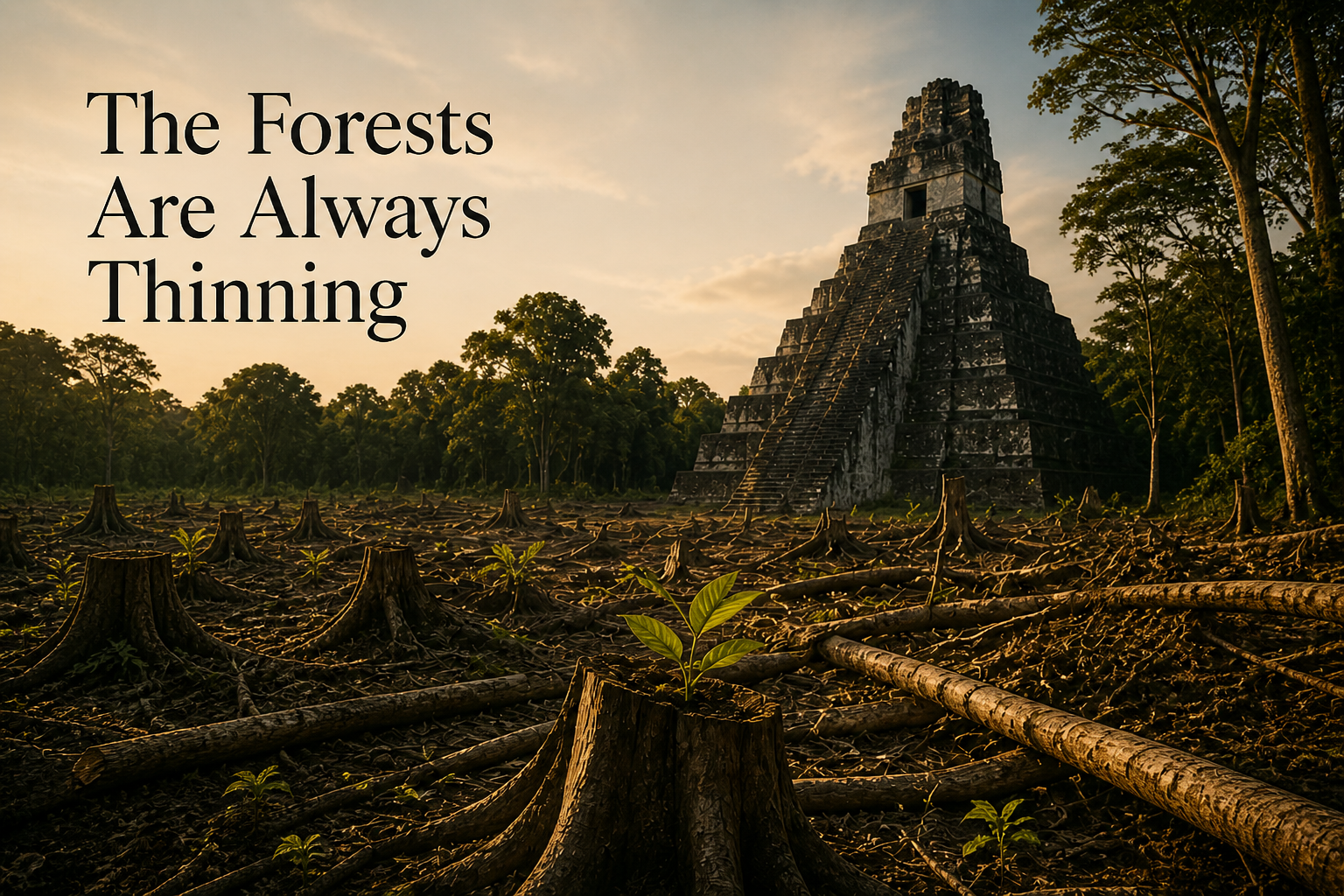
I was on a run last weekend listening to a podcast about the Maya. Not the part where everything goes wrong. That part comes later. The part where everything is going right.
Tikal in the 8th century. Eight hundred people per square kilometre. Plastered temples kept white with lime burned from felled trees. The empire so confident in itself that nobody seemed to notice the forests thinning, or the cenotes running lower than they used to, or the soil on the hillsides washing into the valleys faster than it could be replaced. The mathematicians could calculate dates millions of years into the future. They just couldn't see the next fifty.
By the time the drought hit around 760 (apparently the worst in 7,000 years), the slack had already gone. The systems that would have absorbed it had been quietly disassembled, one decision at a time, by people who thought things were going fine.
I keep thinking about that. Not because I'm building a civilisation. Because the shape of it is familiar.
There's a thing I do, and I don't think I'm the only one, where everything stabilises and I quietly stop doing the things that made it stable. Income settles, deadlines ease, the visa stuff is sorted for the year. The pressure goes. And then so does the discipline. Not in any dramatic way. I don't decide to stop posting, or stop shipping, or stop writing the morning pages. I just notice, three weeks later, that I haven't.
The water's warm. That's the whole problem. If it were cold I'd get out.
It feels like the brain reads stability as we made it and starts unspending the energy that got us there. Which would maybe be fine if the stability were self-sustaining. It isn't, though. The calm is the thing the discipline is producing, and the moment the discipline stops, the calm has about three weeks of inventory before it runs out.
The strange part, the part I find genuinely strange, is that I can watch this happen in real time. I can sit at my desk on a Tuesday and notice, with full clarity, that I haven't shipped anything in two weeks, that I've been telling myself I'm “resting,” that the rest doesn't actually feel like rest, it feels like a slow leak. And I still don't get up and fix it. The knowing is there. The doing is not.
I don't have a clean theory for that gap. I think maybe the discipline that runs on anxiety just doesn't have a job once the anxiety leaves. And the discipline that runs on something else (values, a target you actually care about, a version of yourself you're trying to keep in shape) has to be installed deliberately, and I haven't always done that work in time. So when the urgency drains out, there's nothing underneath holding the routine in place. It collapses softly, like a tent with the poles pulled out.
Probably the Maya weren't lazy either. Probably they were busy. Probably the people in charge of plastering the next temple were being praised for plastering it, and nobody had the job of saying we are running out of trees and the system that grew us this big can't feed us at this size. The feedback loop they needed wasn't in the architecture. The signals that would have saved them weren't loud enough to compete with the signals that were already working.
I think that's the kind of self-sabotage that doesn't get talked about much: the quiet kind, where a working system goes uncared-for until it stops working, and you didn't notice because nothing felt wrong. Nothing feeling wrong was the symptom.
I'm not going to pretend I have the fix. I don't. The honest version is: I noticed it again this week, the slide had already started, and I'm trying to figure out what the smallest thing is I can do today to put one pole back in the tent. Probably ship something small. Probably write the post I've been not-writing. Probably stop calling it rest.
The Maya story doesn't have a moral, exactly. The drought was real, the population was real, the trees were really gone. There wasn't one bad decision. There was a long quiet period where the bad decisions weren't legible as decisions at all. Just defaults, just nothing-changing while everything was changing.
I'm trying to take that as a warning rather than a metaphor. The forests are always thinning a little.
References
- Fall of Civilizations, Episode 3: The Maya, Ruins Among the Trees: Paul Cooper's long-form podcast episode on the Classic Maya collapse.