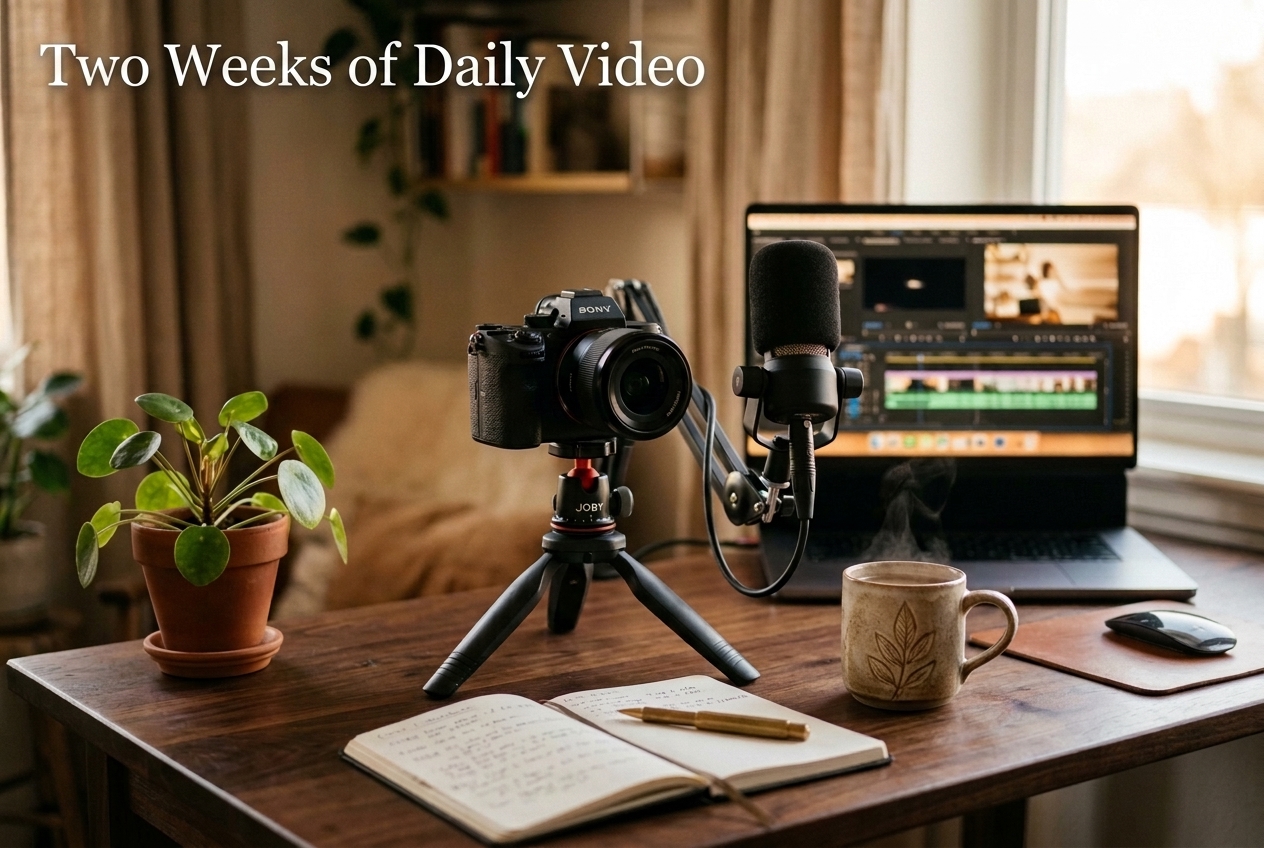
I am two weeks into making daily videos for this blog, and it has been a steep learning curve. What started as an experiment in carousel posts quickly hit a wall. Carousels took an hour and a half to design, yet they regularly landed in the graveyard of content with fewer than 70 views.
To break out of that cycle, I decided to do something deeply uncomfortable: get on camera.
The transition paid off almost immediately. The views doubled to an average of 200 per video, with some hitting 20 likes. One reel, where I talked about Mercury in retrograde and the strange abundance of reels telling me "someone is trying to find me," broke out to over 1,200 views, bringing in comment engagement and a few new followers.
Getting back into social media after a two-year hiatus is a challenge. I originally stepped away due to work, studies, and a basic belief that social media is unhealthy. But if the goal is to raise awareness for the tools I'm building, video content is the only viable path forward.
Here is exactly what I've learned from two weeks of recording daily.
The platform split: Instagram vs. TikTok
Although both platforms host short-form video, their algorithms and audiences expect completely different styles.
On Instagram, over-editing is a liability. I noticed that highly polished videos tend to have a skip rate of around 50%. The videos that perform best are messy, raw, and slightly off-center. Instagram users seem to appreciate authenticity over high production value.
TikTok is the opposite. The "building in public" and developer communities on TikTok prefer a more structured, polished look, though not too polished. The sweet spot seems to be a clean presentation with clear visual hierarchy. For example, in one TikTok, I darkened the background so my face and the highlighted red subtitles would stand out.
Because I didn't have time to edit a separate version yesterday, I posted the TikTok edit to Instagram. The response was flat. TikTok’s fast, flashy captioning styles don't translate well to Instagram, which prefers simpler, more nuanced subtitles without the bells and whistles.
The head-level hook: subtitle hierarchy
Subtitles are a powerful gaze attractor, but their placement dictates how a viewer processes your video.
In my early videos, I put subtitles directly over my head. I quickly realized this is a mistake. Eye-tracking behavior shows that viewers look at the headline of a video first. When subtitles cover your head, they conflict with the natural scanning pattern.
The rule I'm following now is simple: place a slightly larger static headline above your head to grab attention, and position the dynamic subtitles lower down, closer to eye level or chest level.
The smudge on my glasses: progress over polish
Filming has become much easier. I keep my camera set up on my desk and the microphone ready to go. Recording a daily clip takes only 15 to 20 minutes and usually requires just two or three takes. The hard part is letting go of the editing.
Earlier this week, I noticed a distinct smudge on my glasses while editing a clip. In the past, this minor defect would have been enough for me to scrap the video and skip a day of posting. But because I committed to a daily schedule, I posted it anyway.
Adhering to Progress over Polish means accepting that early videos are going to be imperfect. The smudge on my glasses is a reminder that the priority is the reps, not the perfection.
The psychology of posting to crickets
The most draining part of daily video is not the recording; it's the silence that follows.
When you post a video and it sits at a few hundred views, it is easy to fall into the trap of Social Comparison Theory. First formulated by Leon Festinger in 1954, this theory explains our innate drive to evaluate ourselves relative to others. We look at creators who start new accounts and immediately hit a million views, and our 200-view count feels like a failure.
But the goal of these daily videos is not immediate virality. It is about skill acquisition. Each video is a lesson in what makes content work.
The metrics confirm this is a slow build. Over the last two weeks, I've generated 4,123 impressions on Instagram and 5,123 on TikTok. My recent passion project video (about building things purely because they're fun to build) got 52 likes. On TikTok, the videos average about 900 views, but the average watch time is only 7 seconds for a 40-second video.
A low retention rate is a diagnostic tool, not a defeat. It shows me exactly where viewers lose interest. Over the next few weeks, as the filming process remains low-friction, I can start focusing on hooks and editing pacing to hold that attention longer.
References
- Festinger, L. (1954). A theory of social comparison processes. Human Relations, 7(2), 117–140. The foundational paper on the psychological drive to compare ourselves to others.
- D’Ydewalle, G., Praet, C., Verfaillie, K., & Van de Poel, J. (1991). Watching subtitled television: Automatic reading behavior. Journal of Communication, 41(3), 65–78. Eye-tracking research demonstrating how subtitles act as automatic gaze attractors.
- Krugman, D. M., Fox, R. J., Fletcher, J. E., Fischer, P. M., & Rojas, T. H. (1995). Do adolescents attend to warnings in cigarette advertising? An eye-tracking approach. Journal of Advertising, 24(2), 39–52. Early eye-tracking research on how text placement and layout influence visual attention.