Reddit made this feel tractable. I posted in a subreddit as someone who is part of the community, using a transcribed voice note that was fairly raw. The post got 87k impressions, mostly because the room I'd walked into already had the problem I was trying to solve.
TikTok is a different kind of room. Visibility there isn't mediated by whether you show up as a real person in a space where your people already are. It's curated by an algorithm that decides, based on signals you can only partially read, whether your content gets distributed at all. Taina Bucher writes about this as a reversal of the Panopticon model: traditional surveillance derives power from making people feel watched, but algorithmic platforms flip it entirely. The dread is posting something and disappearing from the feed entirely, shown to 40 people and then nothing, not because the content is bad but because the variables weren't satisfied. The 2-second hook, the watch-through rate, whether the video loops cleanly. These seem to unlock distribution, and they don't have much to do with whether the product works.
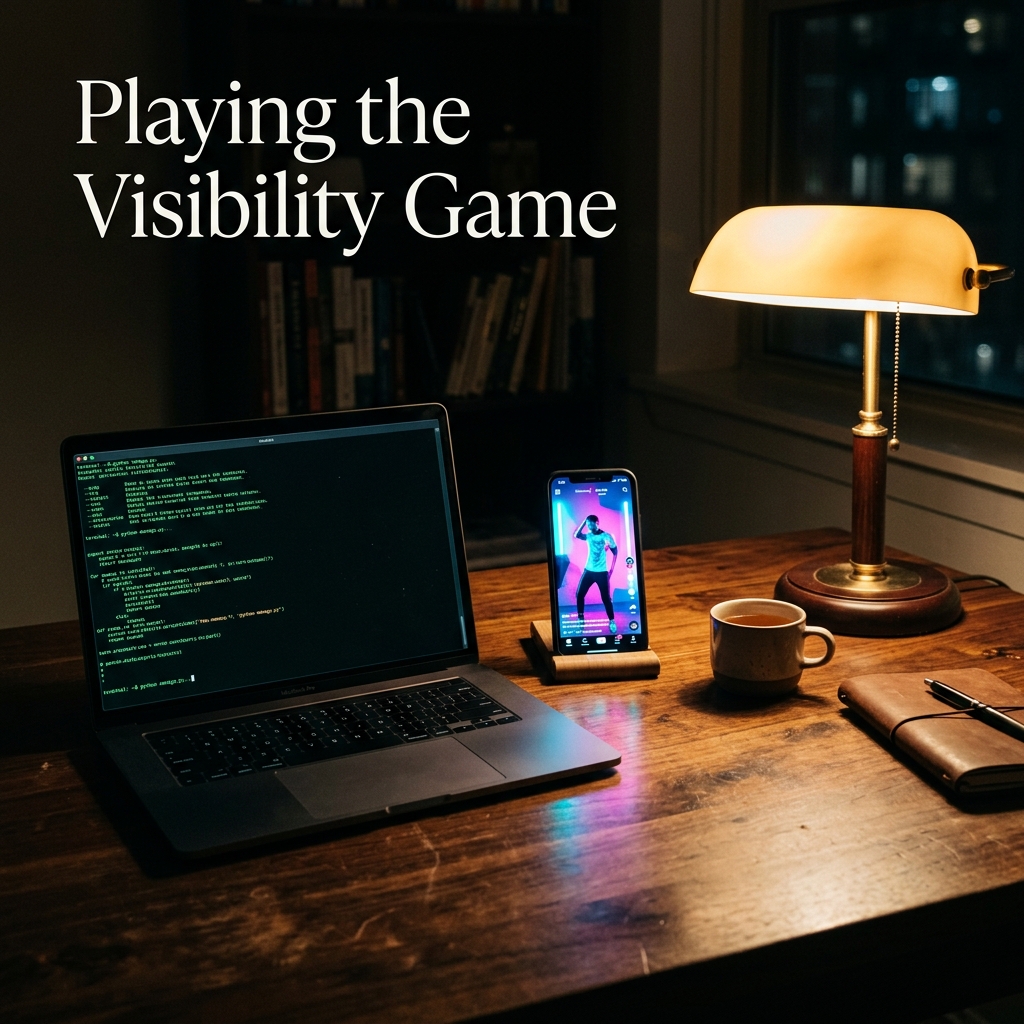
Kelley Cotter calls navigating this the "visibility game." Creators develop a sense of the encoded rules, figure out what the algorithm rewards, and adjust their behavior accordingly. Which sounds manageable until you're the one doing it. OBS Studio is open, there's a screen recording of NudgeCue running, the ffmpeg caption script is in the terminal. The pipeline is technically ready, and the realization sitting there on a Saturday afternoon is that building the software was the natural part.
I'm not comfortable on camera, and the kind of delivery TikTok seems to reward, quick, confident, high-energy from the first frame, runs against how I actually think. Bucher's later work on the "algorithmic imaginary" describes how anxiety around invisible systems starts reshaping your behavior. You start scripting tighter openers. You second-guess the pacing. The product demo starts to feel like a performance, and you're spending more time on the hook than on what the hook is supposed to surface. The gatekeeper is probably imagined as often as it's real, and imagining it warps what you're trying to say.
So I tried building a pipeline instead.
I set up OBS Studio to capture the screen, used ElevenLabs to generate a synthetic voiceover (the Adam Flash model), and wrote an ffmpeg script to burn in captions automatically. The input was a short script; the output was an MP4 ready to upload. It felt like a perfect developer's defense: decouple the thinking from the producing, avoid the camera, and treat content creation like a software compilation process.
But the result felt cold and sterile. It stripped away the very thing that made the Reddit post connect: a real human showing up in a real space. By trying to optimize for the algorithm, I was building a machine that looked like everything else, but felt like nothing.
If I'm going to make video, I'm dropping the synthetic theatre. No AI voices, no high-energy scripted hooks, no hyper-edited loops. Just a raw screen recording and my own unpolished, natural voice. It might not loop perfectly and it probably won't hit the retention metrics the platform wants, but at least it's actually mine.
I'm not looking to opt out. I still want NudgeCue in front of the people who need it. I'm just not willing to let the platform warp how I think just to stop a stranger from scrolling for three more seconds.
The question I keep coming back to is how much of what these platforms ask for I'm actually willing to give. I'm still figuring that out. But I think it's time to get a new camera.
References
- Want to be on top? Algorithmic power and the threat of invisibility on Facebook: Bucher (2012). Argues that algorithmic visibility systems exert power through the threat of disappearing from feeds, inverting the Panopticon's logic. ✓ Link verified.
- The algorithmic imaginary: How people make sense of algorithms: Bucher (2017). On how uncertainty about invisible algorithmic systems reshapes and distorts everyday behavior. ⚠ DOI resolves but content is paywalled, link is valid.
- Playing the visibility game: How digital influencers and algorithms negotiate influence on Instagram: Cotter (2019). Examines how creators develop a practical sense of algorithmic rules and adjust their behavior to gain visibility. ⚠ DOI corrected, see flags below.